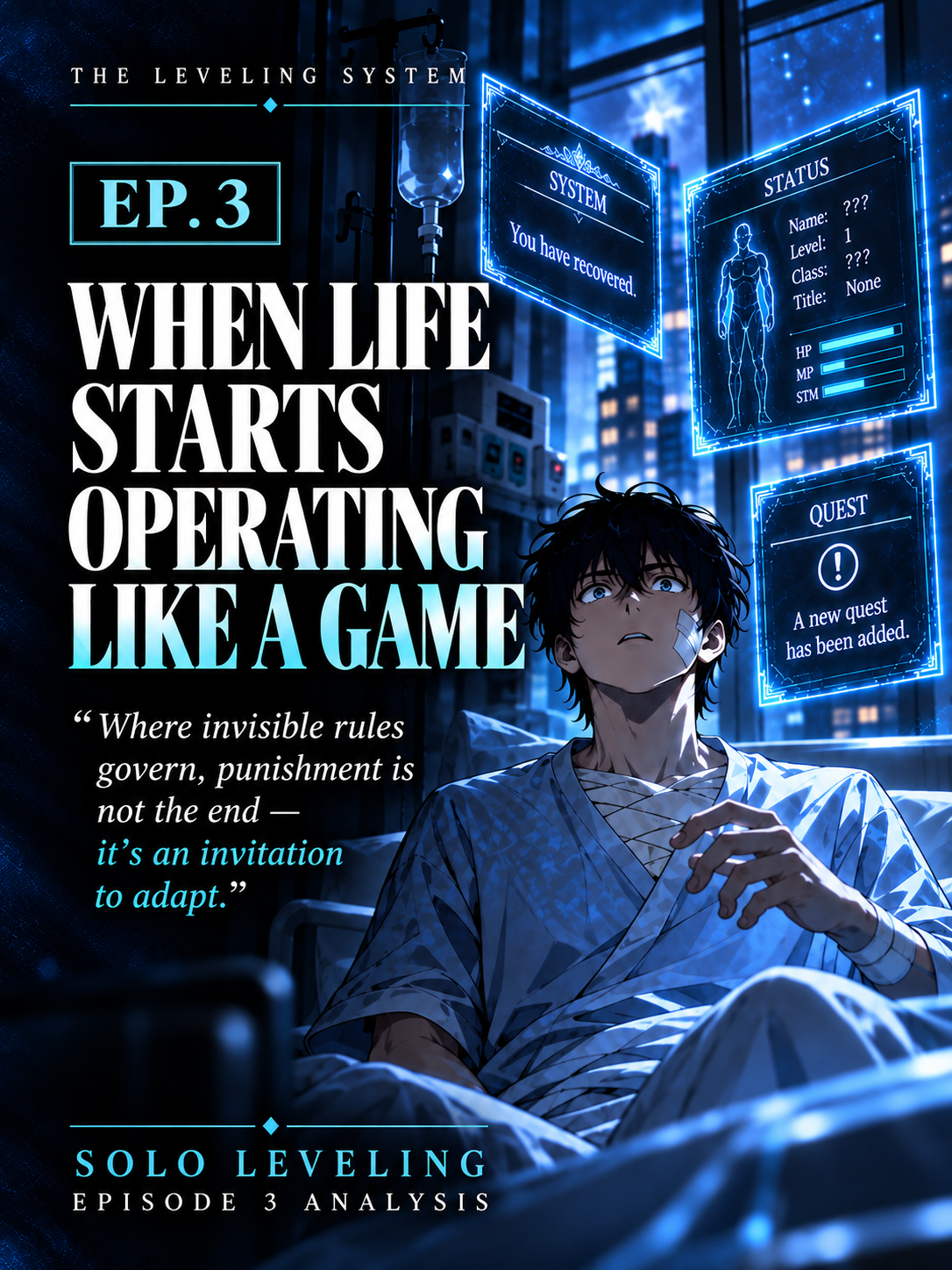
Where invisible rules govern, punishment is not the end — it’s an invitation to adapt.
The Leveling System
Episode 3 of Solo Leveling, “It’s Like a Game,” picks up directly from the conclusion of the double dungeon. After accepting a mysterious message moments before death, Sung Jin-Woo wakes up in a hospital fully healed. What seemed like a dream quickly proves real: he was unconscious for three days, the dungeon has vanished without a trace, and the survivors bear deep physical and psychological consequences.
With no sign of a second awakening, Jin-Woo is still considered weak, while, invisible to others, a system begins operating just for him.
The Awakening That Doesn’t Seem Real
Sung Jin-Woo’s recovery defies any logic of that world. Fatal wounds simply disappeared. Limbs that shouldn’t have returned are intact. At first, the easiest explanation is denial — perhaps it was all just a delusion.
This denial is understandable. The impossible always comes with a price, and waking up unscathed after a death sentence seems too good to be true.
However, the visit from the Hunter Association agents shattered that illusion. Jin-Woo not only survived — he was the only one found alive. Leader Song had lost an arm, and Joo-Hee was left deeply traumatized. The dungeon had simply vanished.
It was no dream.
The Invisible Marks of the Double Dungeon
Even though Sung Jin-Woo is physically unharmed, the episode makes it clear that no one emerged unscathed from the double dungeon. Trauma manifests in different ways.
Song pays with his body. Joo-Hee pays with her mind. Even as a Rank B healer, she now avoids raids, not for lack of power, but due to emotional limits. Solo Leveling is clear: physical strength and psychological stability don’t always go hand in hand.
Jin-Woo’s mark is silent but present. The episode builds this tension gradually, without ever stating it outright.
The System: Rules, Punishments, and Rewards
While evaluators try to understand how a Rank E hunter survived, the power test destroys any hope of a second awakening. The number is low. Ridiculously low.
But the truth lies beyond their reach.
For Jin-Woo, an interface appears, invisible to others — screens, commands, notifications. A system structured like a game, with clear rules, objective rewards, and inevitable punishments.
There is no contract. No conscious choice. Just a cold logic: comply or suffer the consequences.
At this point, the episode begins to shift the narrative focus.
When Ignoring the Rules Has a Cost
The first daily mission is straightforward — a familiar physical training exercise for any One Punch Man fan. Jin-Woo laughs it off. He ignores it. After all, nothing seems real enough to warrant concern.
The system does not negotiate.
When the deadline passes, the penalty is immediate. Jin-Woo is thrust into a hostile dimension, forced to run and survive for hours against giant monsters. There is no glory, no heroic lesson — only exhaustion, fear, and despair.
The system’s message is clear: it doesn’t matter if you believe in it, the rules still apply.
Life as a Game
From this point, Solo Leveling abandons subtlety. Jin-Woo’s life begins to operate like a game.
There are stats, points, skills, random rewards, and instanced dungeons. Measurable progress. Punishment for mistakes.
But the most interesting aspect is not the mechanics — it’s the psychological impact. Living life like a game, often called “life gamification,” is a mental and practical approach that applies game design elements such as points, levels, rewards, and missions to everyday activities.
This logic transforms repetitive or exhausting tasks into clear, measurable, and motivating challenges, helping fight procrastination and increase personal engagement.
Solo Leveling materializes this concept literally: Jin-Woo’s life operates under explicit rules, defined objectives, and direct consequences. What was once chaotic now has structure.
However, as in real life, this logic carries risks. The constant pursuit of instant rewards can cause anxiety, frustration, and a false sense of control. Not everything can be rushed, optimized, or “leveled up” like in a game. The episode reminds us of this through the lingering trauma and the sweat required to keep advancing.
The Source of Strength: Family, Humiliation, and Past
As we see the protagonist training, the episode flashes back to show the origin of his strength. Not talent. Not destiny. But necessity and determination.
His mother in a coma, a victim of the Eternal Sleep Disease. Financial responsibility. Manual labor. Constant humiliation in the dungeons. The label of burden.
While the system offers free points to allocate, Jin-Woo chooses strength. Always strength. Not for refined strategy, but out of emotional memory. Being weak was never abstract to him. It was a repeated experience.
Every training session, every drop of sweat, every allocated point carries that past.
The Returning Trauma in the Face of Danger
As he enters the instanced dungeon, Jin-Woo prepares, plans, calculates. For the first time, he goes alone.
The first enemies are familiar: goblins. Old nightmares now appear smaller. Victory comes. Confidence grows.
Then the game changes.
A red-named wolf monster appears. Stronger. Faster. The weapon breaks. Body reacts before mind. Tremor. Paralysis. Fear.
The trauma from the double dungeon returns uninvited. The system may have changed the rules of the world, but it hasn’t erased the scars.
The episode ends here, at the collision point of newly gained strength and old fear.
Conclusion
Episode 3 isn’t about epic battles. It’s about transition.
The transition from passive survivor to active player. From an unfair world to a relentless but consistent system. From a broken man to someone who slowly begins to rise again.
When life starts operating like a game, ignoring the rules is no longer an option. Understanding them is the first step toward Sung Jin-Woo’s true ascension.
Continue reading
Previous episode: Solo Leveling — Episode 2