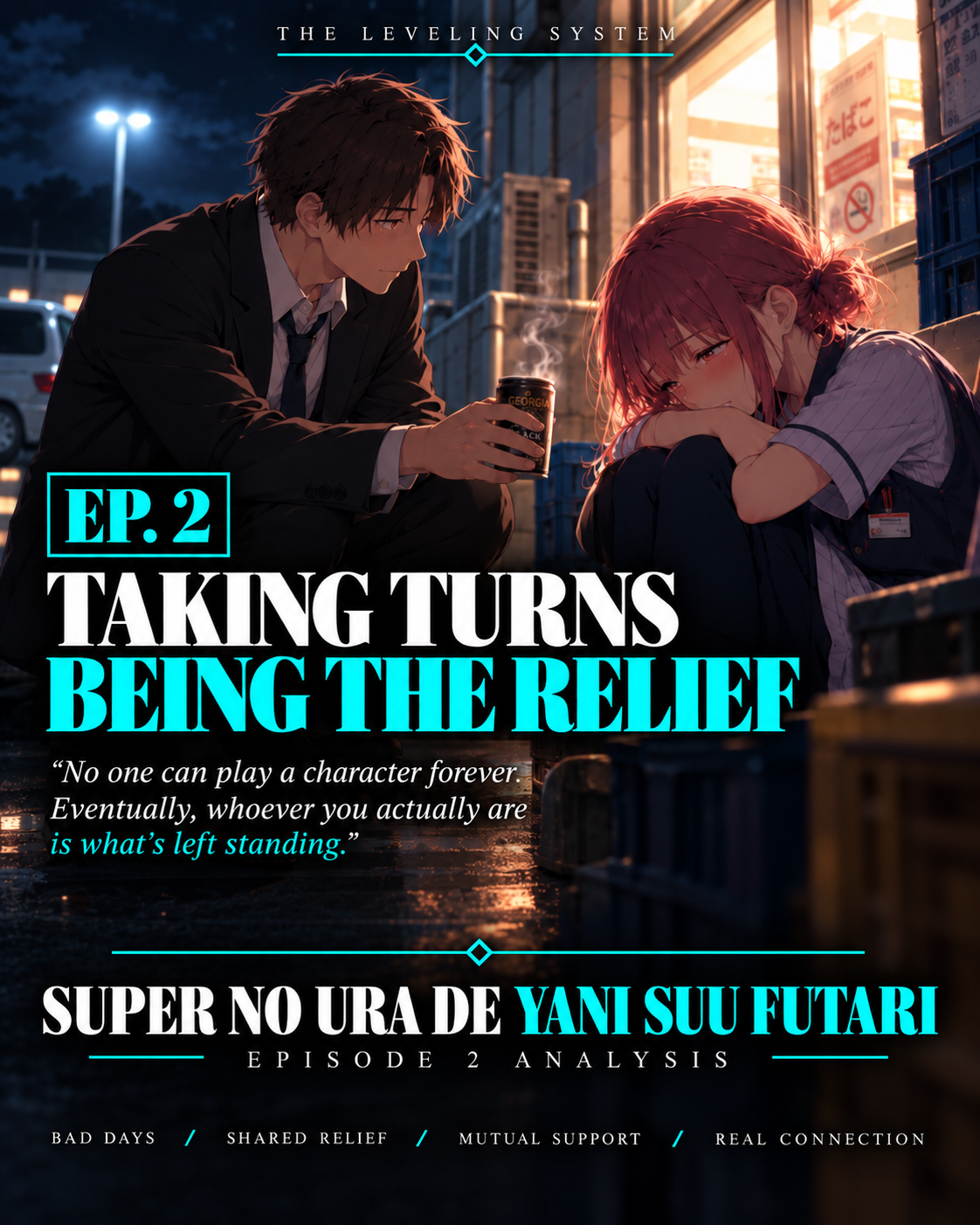
“No one can play a character forever.
Eventually, whoever you actually are is what’s left standing.”The Leveling System
Episode 2 is built around a simple swap. First Sasaki carries a bad day into the store without meaning to, and Tayama is the one who notices something’s wrong. Then, it’s her turn to be the one falling apart, and he’s the one who has to figure out how to help. Between those two moments, the episode makes its clearest statement yet about what these two are actually building together, not just a crush, but something closer to people learning how to take care of each other.
The focus stays on the same two people it always does, except this time each of them gets to be on both sides of the exchange, the one who’s struggling and the one who shows up for it.
He Brings the Problem With Him
Sasaki walks into the store still carrying a work problem in his head, and it shows. He barely reacts to Yamada the way he normally does, distracted enough that she notices immediately. It’s a small moment, but it says something neither Yamada nor Tayama has said outright until now, even behind the Yamada persona, Tayama is paying enough attention to him to register when something’s off.
He leaves anyway, wanting a cigarette, and it’s the cigarette itself that reminds him of her, so he ends up behind the store hoping Tayama is there. What he reaches for first is still the habit, not the person. The conversation only comes after, once the craving has already pointed him toward her.
She isn’t there yet, but she arrives a few minutes later. What she tells him first is telling in its own right, Yamada was worried about him. Speaking through that version of herself lets her show she cares without admitting it’s actually her own curiosity, not Yamada’s, doing the asking.
He explains what happened. A new hire messed up, and he corrected her, reasonably, without raising his voice, something closer to ‘let’s try to do better next time’ than any real reprimand. She started crying anyway, and by the end of it, he was the one who looked like the villain. Nothing in how he describes it suggests he did anything wrong. Tayama doesn’t try to relitigate the moment or convince him he’s blameless, she just tells him something more useful. If the new hire keeps working there, she’ll eventually see who he actually is. Nobody can hold up an act forever. Given enough time, who a person really is always outlasts whatever bad impression a rough day leaves behind.
It’s a small piece of advice, but it’s doing real work for the episode’s theme. People get written off for the worst five minutes anyone’s ever seen of them, and just as often, people write someone off after glimpsing one contradictory side of them, forgetting that a single bad moment was never the whole picture to begin with. Tayama isn’t just comforting Sasaki here. She’s describing exactly the risk she’s running with him, whether she realizes it or not.
Her Turn
The tables turn almost immediately. The tip works, the new hire is fine the next day, and Sasaki leaves work in a good mood. Not long after, Yamada gets pulled aside by her manager, who tells her a customer complained that despite her being one of the store’s best employees, she was coming to work smelling of cigarettes. She heads out back to cope with it the way she always does.
Sasaki finds her there mid-vent, and instead of lighting his own cigarette, he goes and buys a hot drink instead, for her, not for himself, and the show makes a point of showing he isn’t even a coffee drinker, so there’s no mistaking who it’s actually for. He says the reasoning out loud too, repeating something closer to common wisdom than his own idea, that a hot drink does more for a bad moment than a cigarette ever could. It also completes the pattern the episode has been building since his own bad day, the cigarette was never actually fixing anything for either of them, it was just a way of pushing the frustration somewhere it could sit for a while longer. What worked, both times, wasn’t the nicotine. It was someone else showing up.
The two of them also talk, in this stretch, about something closer to the episode’s real thesis: how people can meet someone, like them, and then feel betrayed the moment they see a side that doesn’t match, even when that side was always part of who that person is. It’s a fair description of what idealizing someone actually costs. The version you fall for is rarely the whole person, and the disappointment that follows usually says more about the gap between the two than it does about anything the other person did wrong.
Touched by the gesture, she takes off her own jacket and helps him into it when the cold starts getting to him. Standing side by side while she does it, she quietly holds onto the empty sleeve he isn’t wearing yet, just a beat longer than the moment calls for, without him noticing.
Closing the Distance He Doesn’t Know Is There
By the next scene, spring has arrived, and Sasaki is visibly in a good mood on his way to work. On his way back, he passes by the store, and before going to buy anything, his first urge is to check behind it, to see if Tayama happens to be there. It’s a small shift with a lot behind it, he’s no longer just chasing the comfort Yamada offers, he’s started to want the version of her that isn’t performing anything.
What he actually finds back there isn’t Tayama, it’s Yamada. The context makes it clear enough what just happened, she’d been smoking on her own before he showed up, since the habit belongs to her, and had to snap back into the Yamada persona in the couple of seconds before he came to notice. In that way, he arrives already meeting the mask, not the person underneath it.
They talk, and he thanks her for having been worried about him the day before. She, still speaking as Yamada, brings up Tayama in the third person, telling him Tayama would love it if he kept talking to her, to Tayama. It’s the same trick as before, just run in the opposite direction, her mask saying out loud what she actually wants.
We can also see, in this scene, that the show gives us the tell for catching the switch in real time, her eyes. Wide and open, that’s Tayama, herself, unguarded. Narrowed into the practiced customer-service look, that’s Yamada, the persona doing its job. It’s a light touch, but it means the show trusts us to track the difference even when Sasaki still doesn’t fully register there’s only one person to track.
By the end of the conversation, he notices, almost offhand, how similar the two of them are, both with the same instinct to worry over other people. As he turns to leave, there’s a leaf caught in his hair. She reaches up and pulls it out herself, a small, faintly flirtatious gesture that’s pure Tayama, except she’s the one doing it while still wearing Yamada’s face. It’s enough to make him register, if only for a second, that Yamada can be just as playful as Tayama too. He’s not there yet, but the gap between the two of them is closing whether he notices it or not.
Conclusion
Step back from the specifics and what this episode is really tracking is reciprocity. First he needed someone to tell him a bad moment doesn’t define him. Then she needed the same thing, and got it, in the form of a good gesture instead of a lecture. Both of them reached for a cigarette first, out of habit, and both times it did exactly what cheap nicotine always does here, nothing, just a way of holding the bad feeling at arm’s length instead of actually putting it down. What put it down, in both cases, was the other person choosing to support them. Whatever this relationship turns out to be, it’s stopped being one person leaning on another for comfort. It’s two people learning, clumsily, that kindness works where the cigarette never did.
Continue reading
Previous episode: Super no Ura — Episode 1