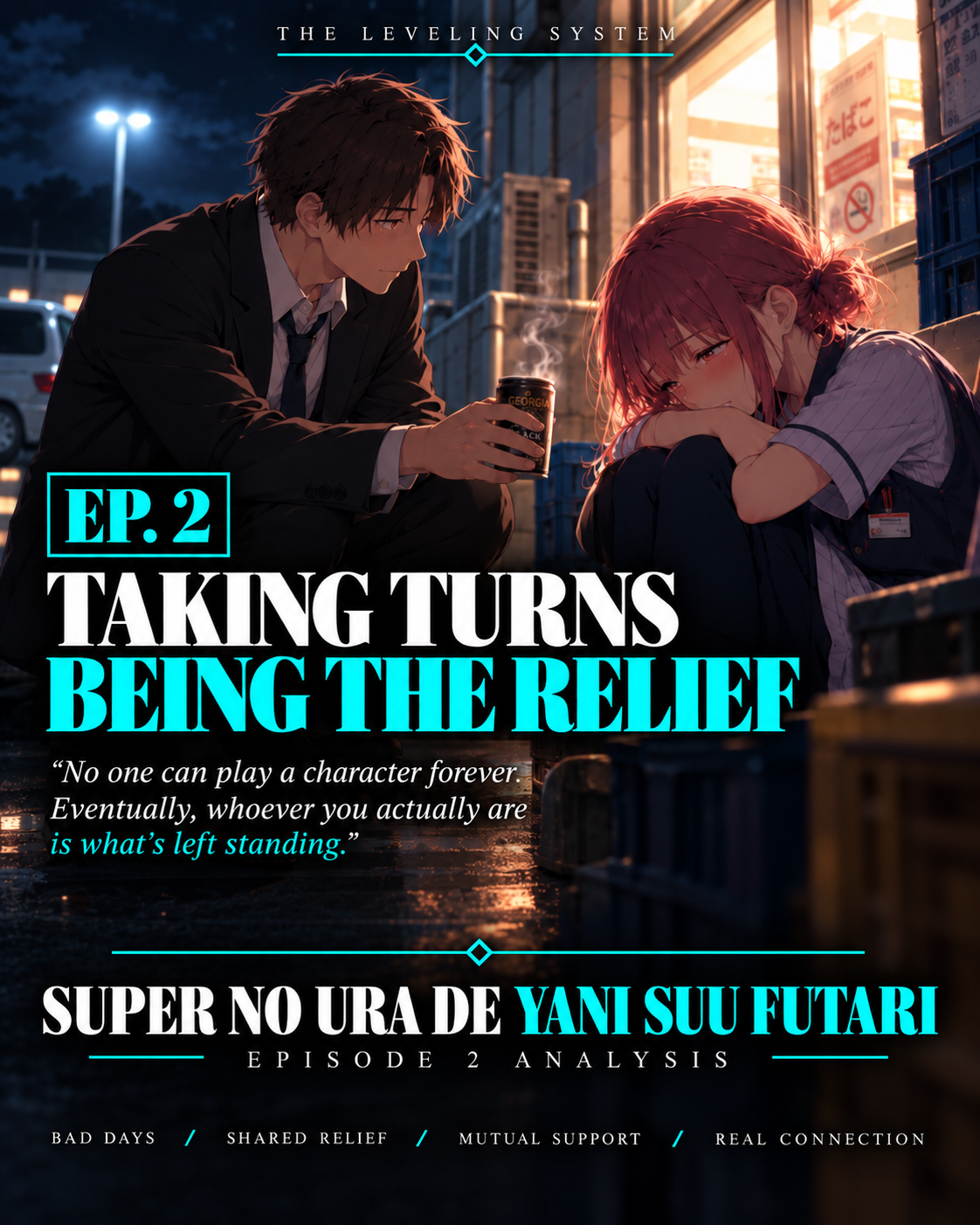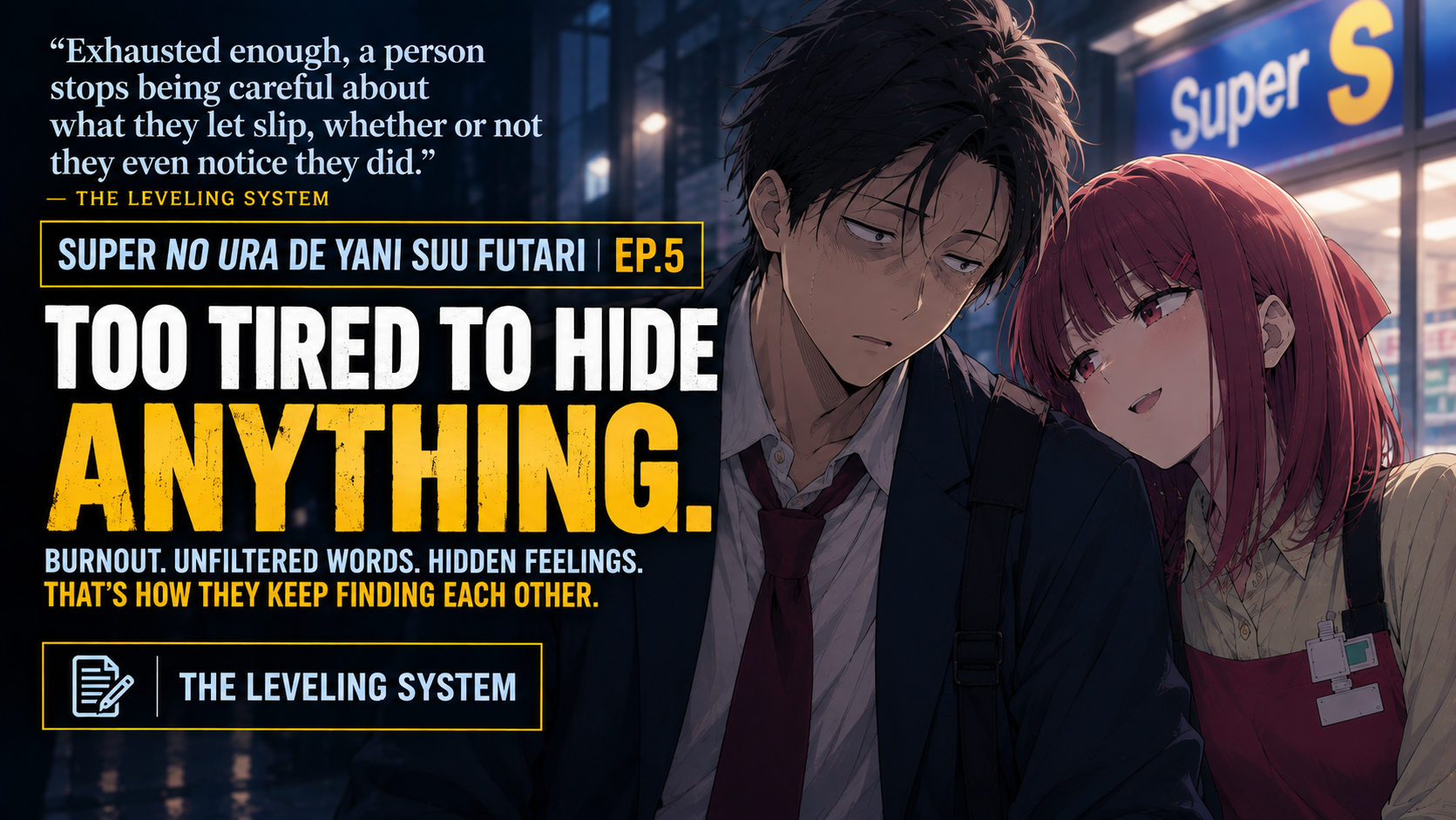
“By the time exhaustion takes enough from us, even what we hide can find its way out.”
The Leveling System
Episode 5 is really about burnout, and about what it quietly takes from a person before it ever gets around to taking their health. Sasaki spends most of it running on nothing, fourteen straight days of overtime, a missed train, an apartment falling apart around him while he’s too tired to notice. The show ties that exhaustion directly to what happens with Tayama, he only says the things he’s been holding back once he’s too worn down to keep holding them back. The words that usually stay half-finished start finishing themselves.
A Ritual for Uncertain Things
The episode opens under a brutal summer heat. Sasaki’s coworker jokes that, working in sales, he knows what it feels like to suffer through the heat while conveniently stationed near the air conditioning. The joke lands twice as well when it turns out that his own unit is broken. That same coworker spends the scene complaining loudly about it, and Sasaki points out, plainly, that he’s doing the exact thing you shouldn’t do, getting worked up about something only makes the something worse, a small, familiar irony most people know and ignore anyway. In the middle of this, Sasaki makes his first bet of the episode, drawing a cigarette from the pack to predict when the AC will get fixed. It’s superstition dressed up as a coin flip, and it works, loosely, mostly because he decides it did.
Wet Pants, Honest Answers
At the store, Goto accidentally soaks him with a hose, leaving him to borrow a pair of pants while his own dry off. What follows is a conversation that starts as small talk and, as this show tends to do, wanders somewhere much more exposed, this time with Goto clearly steering it there on purpose.
Goto tells him he doesn’t need to be so formal. They’re roughly the same age, both around forty, and he’s visibly stunned that someone his age is running a store this size. She asks how he reacted when he learned Tayama’s age, since he clearly already knows she’s younger than him. He admits he never actually asked, and when Goto presses him on whether he’s even interested in other people, what comes out is closer to a confession than he seems to realize he’s making. Framed almost entirely as self-deprecation, it’s essentially his way of asking how he could not end up liking someone who listens to an old man like him this attentively. It’s a genuinely soft admission, disguised as an insult toward himself.
Goto then, delighted, corners him into admitting outright that he likes her. However, it turns out Tayama has been listening the whole time. But instead of acknowledging that she heard him, she simply gives him a number, twenty-four. Her age, offered sideways rather than directly. It’s the same instinct that has been running through this relationship all along, saying the true thing without quite saying it.
Fourteen Days
The show shifts hard right after this, into what’s essentially a slow-motion burnout. His boss leaves for vacation without properly delegating anything, and because Sasaki is senior enough that everyone defaults to him, the disorganization lands entirely on his desk. Underneath all that chaos is something simpler, he never once says no. People keep handing him their own problems, and he keeps taking them, probably not just because he’s the only one who can, but because turning someone down isn’t a move he seems to know how to make. Being generous with your time isn’t the flaw here, refusing to ever delegate any of it back is, and a person who absorbs everyone else’s slack indefinitely isn’t being resilient, they’re just delaying their own collapse.
He misses his last train home. The next morning starts at six thirty, a detail the show repeats deliberately, since the version of him leaving the office that late implies workdays stretching well past twelve hours. He runs out of cigarettes entirely, having gotten home too late the night before to buy more, which barely registers next to everything else falling apart. His backpack is still sitting by the table, exactly where he must have dropped it when he got home and collapsed, his apartment fills with trash he has no time to deal with, and the rain outside never really lets up. Fourteen days pass this way, and for all of them, he doesn’t see Tayama once.
What’s Left When You Stop Pretending to Be Fine
When he finally makes it back to the store, Tayama asks for his help drawing rain charms for the shop, stick figures meant to ward off bad weather. It’s such a small request that it barely hints at the emotional turn that’s about to happen.
First he draws Goto, close enough to get a laugh out of her, then draws Tayama, and when she tells him it looks just like her, she adds, almost offhand, that it’s probably because he’s always watching her.
Something in him goes quiet after that. Worn down enough that his usual filters aren’t holding anymore, he starts talking almost to himself about how good this moment feels, sitting there after everything he’s just been through. And when she asks what he’s actually enjoying, he deflects to the cigarette rather than finish the thought.
But the reflection keeps going anyway, working this much made him forget something as simple as actually enjoying a cigarette in the rain. Overwork doesn’t just exhaust a person, it can erase whatever they were enduring the exhaustion for in the first place, a relationship, a family, whatever the word ends up being.
He falls asleep right there, which only happens because some part of him has decided this is safe. Tayama stays with him while he does, eventually reaching over to take the cigarette from his mouth herself.
A Message on His Hand
He wakes up the next day, a day off, mercifully, having forgotten to turn off his alarm. On his hand, in her handwriting: “Well done!”. A phrase she’s used before, but written there, on him, while he slept, it reads less like a joke and more like something she genuinely meant.
The Bet That Gives Him Away
Later, on his day off, he finally cleans the apartment that fourteen days of exhaustion had allowed to fall apart, then heads out. Tayama, meanwhile, is caught eating ramen despite having said she’d cut back, turning defensive rather than brushing it off when Goto brings it up. Goto offers her a shift swap, since one is genuinely needed and it’s easier for Tayama to take it, or an alternative that’s clearly going to be worse. Tayama picks the swap without hesitation and heads out.
Spotting Sasaki shopping from a distance, she decides against surprising him as Tayama and shows up instead as Yamada in casual clothes, catching him so off guard he drops everything he’s holding. Flustered by how unexpectedly casual she looks out of context, he starts reciting Japanese tongue twisters just to hold himself together, while she stands there grabbing candy off the shelf, unable to settle on just one. He finally stops her by suggesting they let a cigarette decide for her, drawing the first one that comes out of the pack, and while he’s at it, explains the actual rules of the game he’s been quietly running on himself the whole episode. If the first cigarettes come out, he leaves work early. If the second, he takes the week off. If the third, he sees someone he wants on register duty. He catches himself just as the name is about to come out and doesn’t finish it.
That stumble is worth sitting with more for what it leaves open than for what it settles. Read one way, it’s exactly what it looks like, something in him almost said her name outright, out of habit, and he caught it before it landed. That’s the reading Tayama settles on once she’s alone with the memory later, deciding it was Yamada he meant all along. But there’s a second reading sitting right next to it that the show never quite closes off. He doesn’t show anything like the mortified reaction that’s basically become his tell every other time Yamada comes up between them directly. If her name really had been the thing catching in his throat, wouldn’t he have reacted the way he always does? The show doesn’t resolve which reading is correct, and it doesn’t need to, because the version Tayama settles on says at least as much about what she’s afraid is true as it does about what actually happened. Alone later, she replays the cigarette game, this time giving each possible outcome a meaning of its own for the two of them. She accidentally pulls out four cigarettes instead of one, then declares aloud that this must mean something bad is coming.
Fittingly, the episode ends on him so lost in thought that he walks out of the store without paying for something, forced to jog back and apologize on the spot. In fact, something bad did happen.
Conclusion
What actually connects this episode’s two halves is what exhaustion does to a person who never learned how to say no. Sasaki spends fourteen days absorbing everyone else’s work without once pushing back, and the same instinct that keeps him from delegating a single task is the instinct that usually keeps him careful around her too. Strip both away at the same time, and what’s left is a man who falls asleep somewhere he trusts without deciding to, and starts a sentence he never should have started in the first place, only to leave it unfinished. He isn’t performing anything in either moment, he’s just too tired to keep doing it. Whether the name he swallowed was actually hers matters less than what the swallowing proves either way. Whatever he’s usually careful not to show her is still right there, waiting for the moment he runs out of energy to hide it.
Continue reading
Previous episode: Super no Ura — Episode 4