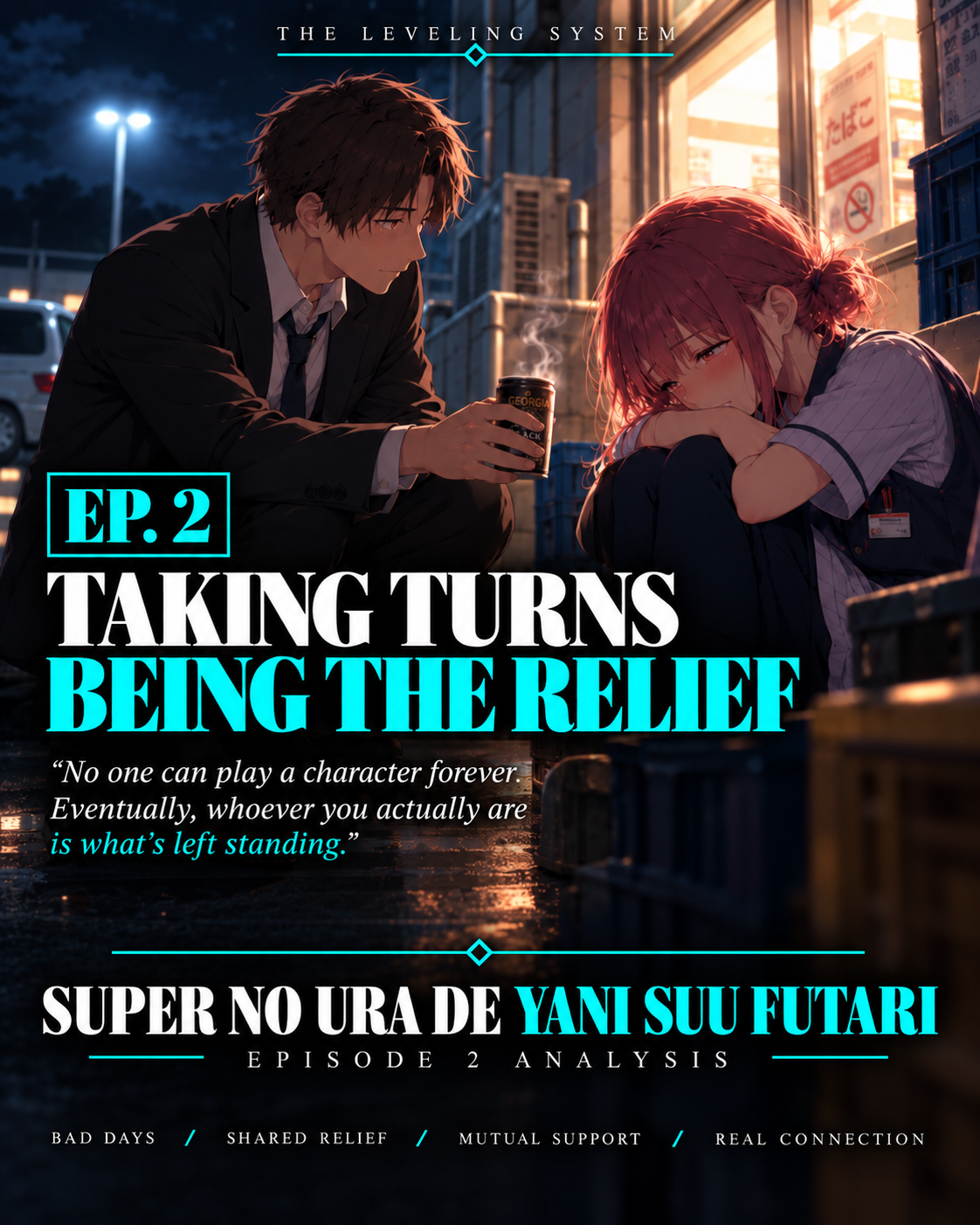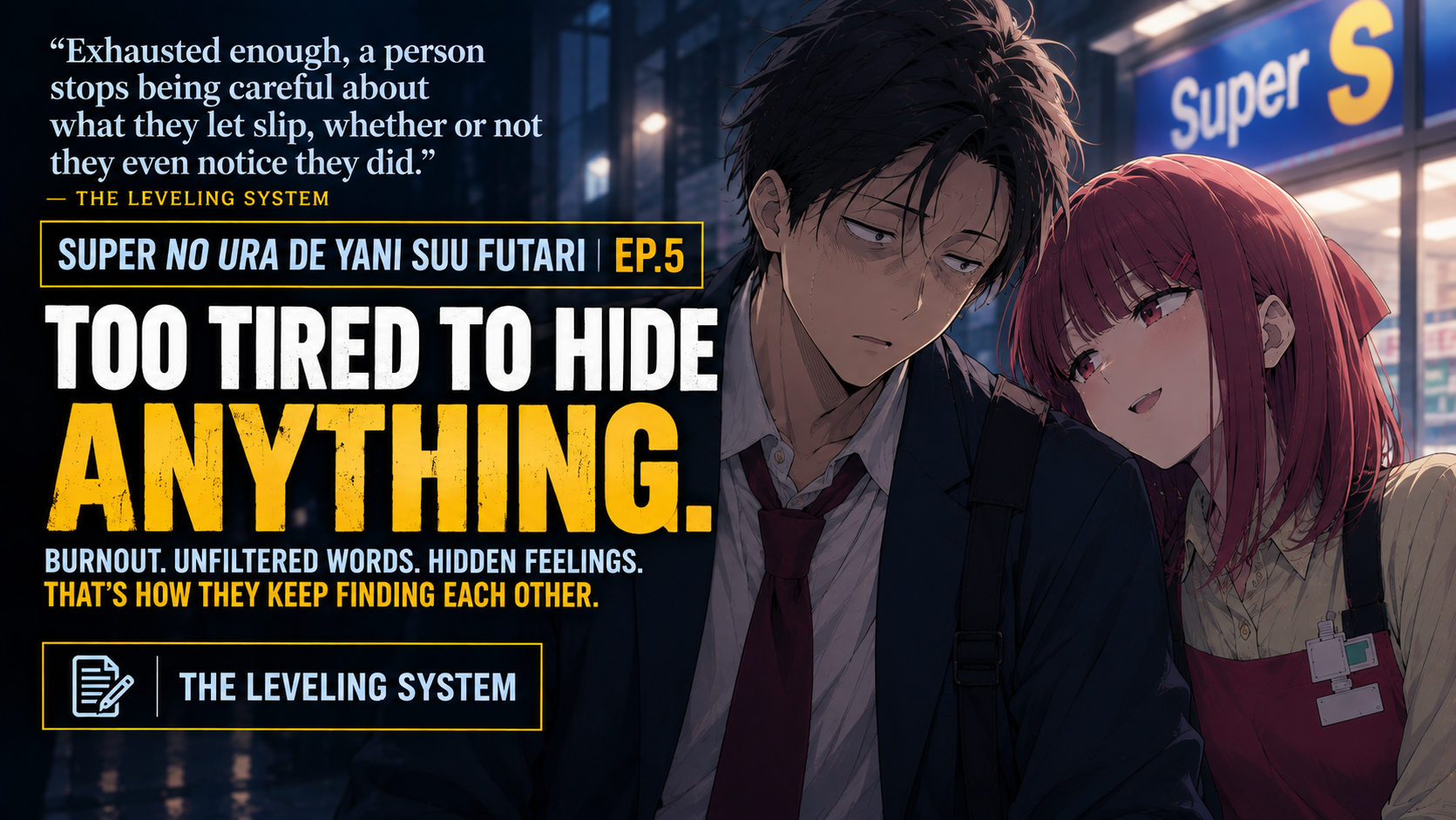
“Nobody falls for someone over one grand gesture.
They fall for the sum of every ordinary night nobody else was watching.”The Leveling System
Episode 4 isn’t about what happens to Sasaki and Tayama so much as what they do with it afterward. A rough day, a small embarrassment, a joke gone sideways, none of it means much on its own. What matters is that each one gets brought up behind the store that night, giving the other person something to react to.
Three separate threads run through the episode: a phone lesson, a joke that lands somewhere neither of them expects, and an ice cream he never buys. Each one works precisely because it never tries to be anything more than ordinary.
Forced Into the Present
The episode opens by making fun of Sasaki’s age outright, reading glasses on, still carrying a flip phone a younger coworker openly mocks him for. He has no real interest in upgrading, at least not until the phone makes the decision for him and simply dies. He buys a smartphone and predictably has no idea how to use it, fumbling even something as basic as taking a selfie.
Teaching an Old Dog New Apps
He brings the phone to Tayama and asks her to walk him through it. She tries, patiently at first, though it quickly becomes clear he isn’t really absorbing any of it, to the point where she just starts doing all of it herself, on his behalf, rather than bothering to keep explaining. She spends the whole lesson teasing him, promising to enlarge the text on his phone if he keeps his glasses on when they talk. At one point, she even pretends to save her own number under Yamada’s name, clearly enjoying how easily she can make him flustered, before admitting that she was only kidding. He doesn’t come out of it knowing much more about his phone. What the scene actually accomplishes is closeness dressed up as a chore neither of them would call a date.
The Ritual Nobody Sees
The episode then cuts to something it hasn’t shown this plainly before, Yamada getting ready for her shift. It plays out almost like a transformation sequence, taping her earrings down, reapplying deodorant to cover the smell of smoke, and most tellingly, visibly shifting her voice into the more polished register she uses at the register. It’s the clearest the show has ever been about how much deliberate construction goes into being Yamada, not a different woman, but a performance built out of dozens of small, practiced adjustments.
In the middle of that routine, she looks at a photo she took of Sasaki without him noticing, and smiles at it before getting back to work. The tenderness sits right next to the stagecraft, without the show treating that as a contradiction.
A Company Named for the Opposite of What It Gives Him
A small, sharp detail worth pulling out on its own, Sasaki’s employer is Genki Shoji, a name built on genki, meaning wellness or vitality in Japanese. He leaves that office exhausted more often than not, occasionally pulling shifts that stretch deep into the afternoon, and Tayama has teased him more than once about working somewhere that’s clearly grinding him down. The company’s name promising the exact opposite of what it delivers isn’t dwelled on, but it doesn’t need to be.
Fortune by Cigarette Brand
A coworker tells Sasaki about an online quiz that supposedly reveals your personality based on your cigarette brand, framing it as something younger people are into. Sasaki, characteristically credulous, brings it straight to Tayama, who clocks it as nonsense on sight but plays along anyway. His result lands on something about looking down on people while secretly leaning masochistic. Hers lands on having two personalities and a surprisingly strong libido, and the part that actually lands, for anyone watching, is the two personalities half, funny precisely because it’s true in a way only Tayama in the scene truly understands.
He fails to read it entirely, and when the joke’s other half registers a beat too late, he drops to his knees on the spot to apologize, completely overcorrecting for something she’d already let go, since she understood he only meant to make her laugh. What actually rattles her is what he says right after, that she really does seem to have two personalities. For a second she tenses, certain he’s finally connected Tayama to Yamada. Then he follows it with something softer, that despite coming off cold, she’s kind too, and that’s what actually sets her off. She grabs a cigarette, shoves it in his mouth, and lights it herself, clearly angry.
It’s worth sitting with why. Being caught would blow up the whole arrangement, but some part of her clearly wants to be caught anyway, or she wouldn’t be this worked up every time he gets close and then doesn’t quite get there.
Self-Sabotage at the Register
The next day, still turning the previous night over in his head without knowing what exactly he did wrong, Sasaki avoids Yamada’s register out of guilt he can’t fully explain, deciding on the spot he doesn’t deserve to be in her line. It’s a small, familiar kind of self-punishment, assuming the worst about yourself before anyone’s actually accused you of anything. Yamada solves it herself, waving him over to her open register without making it a thing. For a moment, the two of them just stand there in complete silence, and the Yamada persona simply slips away. Her manager, watching from across the store, clearly suspects something funny just happened.
Short Sleeves and a Jealousy She Won’t Name
Summer arrives, and on a miserably hot day, Sasaki spots a kid eating ice cream on his way home and decides to grab one himself. At the store, he finds Yamada working the afternoon shift in short sleeves for the first time. Thinking she looks incredibly cute, he gets so flustered by the thought that he abandons the ice cream entirely and leaves.
The next night, Tayama calls him out on it immediately, guessing exactly why he left without him having to explain. He admits, still visibly flustered, breaking into a cold sweat, that Yamada looked cute in short sleeves. He then asks, out of genuine concern, if she isn’t hot wearing her jacket in this weather. She plays along, teasing that she’s got something light on underneath anyway, and pulls the jacket open to prove it, expecting some kind of reaction. What she gets instead is him asking, completely sincerely, if she isn’t cold now with her stomach exposed. The gesture that was supposed to fluster him lands nowhere near where she intended, and she snatches the jacket he offered her, frustrated as she calls him some kind of arm freak. That night, alone in her room, she genuinely considers cutting back on ramen, quietly working out that he’s apparently more into arms than stomach, shaping herself around an image she isn’t ready to explain to anyone, least of all herself.
Conclusion
Strip away the gags and what’s left is a couple’s rhythm without either of them using that word for it. The smartphone lesson, the fortune-telling detour, the register standoff, the short sleeves, none of it is a plot point on its own. What matters is that each one gets carried into the next conversation, referenced, teased about, built on, the way two people who see each other constantly end up narrating their day back to one another without ever deciding to. He’s slow, she says so herself more than once, but slow isn’t the same as unaffected. He notices things. He just keeps filing them under the wrong name.
Continue reading
Previous episode: Super no Ura — Episode 3