“You can learn what people value by what they carry around with them.”
The Leveling System
Episode 7 moves through three stretches, an exchange of handwritten notes, a ghost story behind the store, and the end of summer. On the surface they have little in common. What connects them is the rhythm this relationship has been running on since the start. Every time one of them gives something, the other finds a way to give it back, and this episode makes that rhythm visible enough that both of them end up carrying the proof around.
It also cracks a mask the show hadn’t pointed at yet. Not Yamada, the persona Tayama wears at work, but the cool, unshakable image Tayama keeps up even when she’s supposedly being herself. The work persona, it turns out, was never the only one. People rarely stop performing just because they’ve clocked out. They adjust who they are depending on who’s watching, and the Tayama who teases Sasaki behind the store has an image to protect too, just a less obvious one.
A Note for Each of Them
The episode opens on a gag that quietly sets up everything after it. Offered the chance to take the store’s staff pay-raise exam, Yamada slips into model-employee mode, insisting she’s happy just to work there and doesn’t need more money, an obvious dodge to get out of studying. Her superior isn’t buying it and starts teaching her on the spot, and within minutes Yamada is nodding off. Even the work persona has a second use, getting her out of things she doesn’t feel like doing.
Two weeks later, Sasaki still hasn’t seen her at the register. On his way out of the store, his mind starts running through every bad explanation he can think of, illness, burnout, getting fired, and worse, until he catches himself and says, out loud, that he’s worrying too much for a man whose only connection to her is the checkout line. Naturally, Tayama is standing right next to him when he says it.
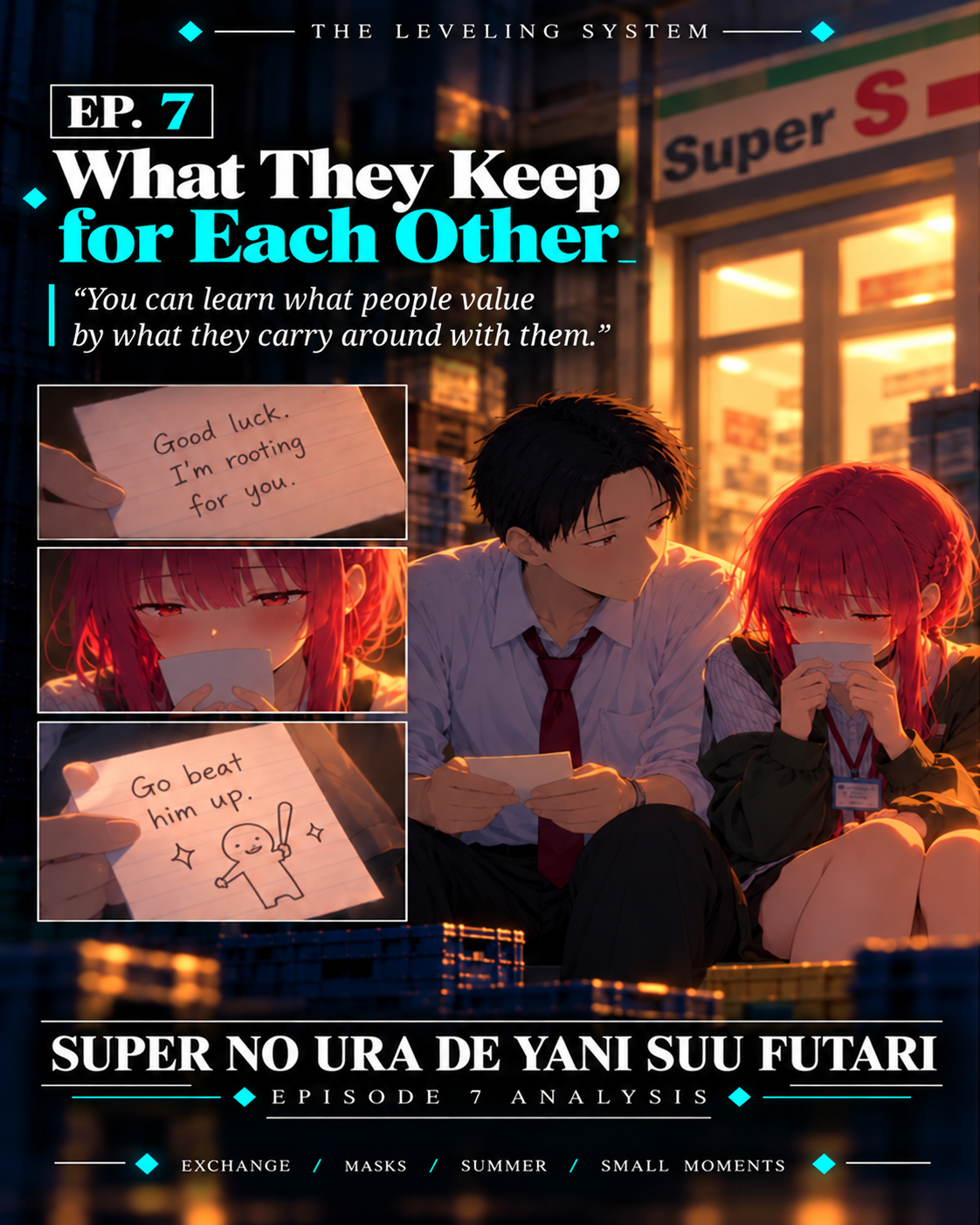
Behind the store, she explains that Yamada has been studying, and he apologizes for always pumping her for information about Yamada. It’s a funny apology to receive, since she’s the one who’s been pulling information out of him all along, from behind an identity she invented. She does it again a moment later, asking him to write a few encouraging words on a piece of paper, without saying what they’re for. Anyone watching knows exactly where that paper is going, but Sasaki writes it without stopping to ask why, which says everything about how slow he is to catch on. Only after he hands it over does she tell him it’s going straight to Yamada, which is to say, to herself. He panics, convinced Yamada would only be discouraged by a note from an old man, his self-esteem as sturdy as ever. Tayama guarantees the opposite. Then she hands him a note of her own, to open the next time his awful boss gets to him. By the end of the conversation, each of them is carrying something the other wrote.
Care That Travels Both Ways
The note gets its use in the very next scene, when Sasaki’s boss argues with a client whose contract Sasaki had closed and then takes his frustration out on him. When he finally opens the note, it reads “Go beat him up,” signed by Tayama, next to a little doodle of a figure holding a baseball bat, and he just laughs, the bad day suddenly a lot lighter. On Yamada’s side, the exam she’d been half-heartedly preparing for turns into a pass once she starts actually trying, and the show is clear about what changed. She credits her “slow fan” and opens his note, which says simply, “Good luck. I’m rooting for you.”
Each of them gave the other exactly what they needed, at almost the same moment, and the exchange is complete even though only one of them knows it was an exchange. That’s the episode’s real argument. A relationship doesn’t need both people to give the same thing, but it does need care to travel in both directions. When it only flows one way, it tends to turn into something else, dependence, resentment, or a comfortable arrangement nobody looks at too closely.
The show reinforces this by rhyming the two sides. Sasaki reads his note at his desk right beside Suzuki, who’s announcing that his wife’s lunch has rescued a terrible morning, the same pairing Episode 6 used. When the boss walks up behind him, Sasaki crumples the note out of sight, panics over having damaged it, and tucks it into the holder where he keeps his train pass. And both of them end up finding something worth holding on to in the other’s words, even if those words help them in different ways. That shared instinct is its own form of affection. Two people who keep landing on the same gestures and the same instincts are paying close attention to each other, whether or not they’ve admitted it.
What Each of Them Keeps
Back at the store, Tayama tells him Yamada passed, and he lights up, genuinely and openly happy for her. It’s a small reaction, but it’s one of the clearest signs of how much someone matters to you. Showing up when things go wrong is one form of care. Being glad when things go right for someone, with nothing in it for you, is another, and it’s much harder to fake. One study of dating couples even found that how partners responded to each other’s good news was more closely tied to the health of the relationship than how they responded to bad news. Sasaki passes that test without even knowing he’s taking it.
Then he backpedals, calling himself a stranger who shouldn’t even know this, and decides his note couldn’t have helped much. She insists it did. As he’s saying it, his pass holder drops, with her note tucked inside, creased but kept. She teases him with it, and he admits, embarrassed, that he’s been keeping it as a mayoke, a protective charm meant to ward off bad things, which makes sense given the boss he’s trying to survive.
Later, lying in bed, she replays the word she teased him for using and thinks he could have just asked her for a fresh one, since that one was all crumpled. What stays with her isn’t really the word, though. It’s the fact that he kept the note at all. Something she handed him as a joke has become something he carries for reassurance. The show also makes sure we see she still keeps the pocket ashtray he gave her back in Episode 3. She now knows how much her note means to him. What he doesn’t know is that she’s been holding on to his gift just as carefully.
Afraid of Being Seen Afraid
The second stretch starts with a ghost story. Maezawa tells the staff that something haunts the back of the store, and Yamada brushes it off, saying the only thing that scares her is making mistakes at work. It’s an image she clearly cares about keeping, someone who doesn’t rattle.
When Sasaki shows up later, she sneaks up on him to scare him. It works, but for a second her own face isn’t the confident one she usually wears. When she brings up the ghost, he barely reacts, since he already has enough trouble with the living. Then he asks, innocently, whether she’s the one who’s scared. She snaps at him, defensive and angry, which answers the question better than any denial could.
Then something behind the wall moves. Sasaki tells her to stay back while he checks, and the cool image falls apart all at once. She hides behind him with her eyes shut and grabs a fistful of his jacket, a call for help she’d never say out loud. He reaches a hand back, barely, the way someone does when they’re placing themselves between a person and whatever’s coming.
The ghost turns out to be a regular customer’s dog that Goto is looking after, but by then the scene has already done its work. Yamada is a mask built for customers, and it protects her job. The cool image works differently. Nobody trained her into it, and the teasing that comes with it is genuinely hers, but she clearly doesn’t like being caught without it. She denies being scared to her coworkers, bristles when Sasaki asks, and only drops the act when fear makes the choice for her. It fits a pattern the show has been building for a while. Tayama can show almost anything sideways, through a jab or a few hits on the arm, but admitting what she actually feels, plainly and in the moment, is the one thing she keeps avoiding. Episode 6 ended the same way, with a confession she backed away from the second she had the chance.
Sasaki may be slow about most things, but in that moment he understands exactly what happened, that she was scared and didn’t want it seen. As he leaves, he apologizes for bumping into her, as if that’s all that happened. She realizes immediately that he saw everything and is choosing not to say it, and she yells “idiot” at him, which is about as close as she gets to thank you. He could have teased her the way she teases him. Instead he hands her a way to keep her pride, and that’s as much a form of protection as standing in front of her was.
The dog gets one more scene the next day. When Yamada’s coworkers ask what it’s called, she tells them, jokingly, that its name is “Sasaki.” Goto steps in to correct her, that’s not the dog’s name, and Yamada’s only defense is that “he gets on my nerves,” the kind of complaint people make about someone they like when they’re not ready to say so. The joke also works outside the episode. The end credits reveal that the dog, whose actual name is Daigoro, is voiced by Takuya Sato, the same actor who plays Sasaki, a casting choice one of the show’s two directors says came from simply asking him at a drinking party.
The End of Summer
Summer is almost over, but the heat hasn’t eased up. At work, Sasaki’s boss tells him to stop being soft about it, so he spends the day just putting up with it, and he’s still complaining on his way back to the store. It’s exactly the right mood for what’s waiting for him there.
When he reaches the back of the store, Tayama turns up right after him and complains that he showed up the moment she’d stepped away, a hint that she’d been waiting there with something planned, payback, it seems, for the time he saw her scared.
She sits with her feet in a tub left over from the store’s summer stock, smoking, and tells him he can do the same. He assumes she means sharing the tub and gets flustered, and she catches it immediately and teases him for it before setting him straight with a hose aimed at his feet instead.
He drifts off, enjoying the cold water after a hot day, and that’s when she pulls out a water pistol and soaks him, visibly thrilled to have finally pulled it off. The camera moves in on her face, and the frame fills with light, as if something were shining right in front of her, a flourish that probably shows how she looks to him in that moment. He laughs. When she demands to know what’s so funny, he apologizes and admits he actually enjoyed it, which ruins the whole point of the prank. She complains there’s no fun in teasing him if he likes it, and he doesn’t even realize he was being teased. So she aims again and tells him she’ll explain if he can dodge, and the two of them spend the end of summer chasing each other like a couple.
It closes the summer the show opened back in Episode 4, when the sight of Yamada in short sleeves was enough to send him home without his ice cream. This time he stays, soaked and laughing. And even her revenge doesn’t land the way she planned. She sets out to get even, and he takes it as a gift, which is this episode in miniature. Whatever one of them sends the other’s way, the other finds a way to receive it as something good.
Conclusion
Three stretches, one pattern. The notes show care traveling in both directions, and the show keeps rhyming the two sides until both of them are literally carrying the proof, a crumpled note in a pass holder, an ashtray she still holds on to. Sasaki lighting up at the news of her exam shows the same thing from another angle, care that wants nothing back.
The ghost story adds the harder half. Giving comes easily to both of them. Admitting what they feel does not, and Tayama keeps a second mask for exactly that, one that has nothing to do with work. It only slips by accident, with her eyes shut and a fist in his jacket, and Sasaki answers by protecting her without making her pay for it in pride. By the time summer ends, neither of them has said anything out loud. What they keep for each other says it for them.
Continue reading