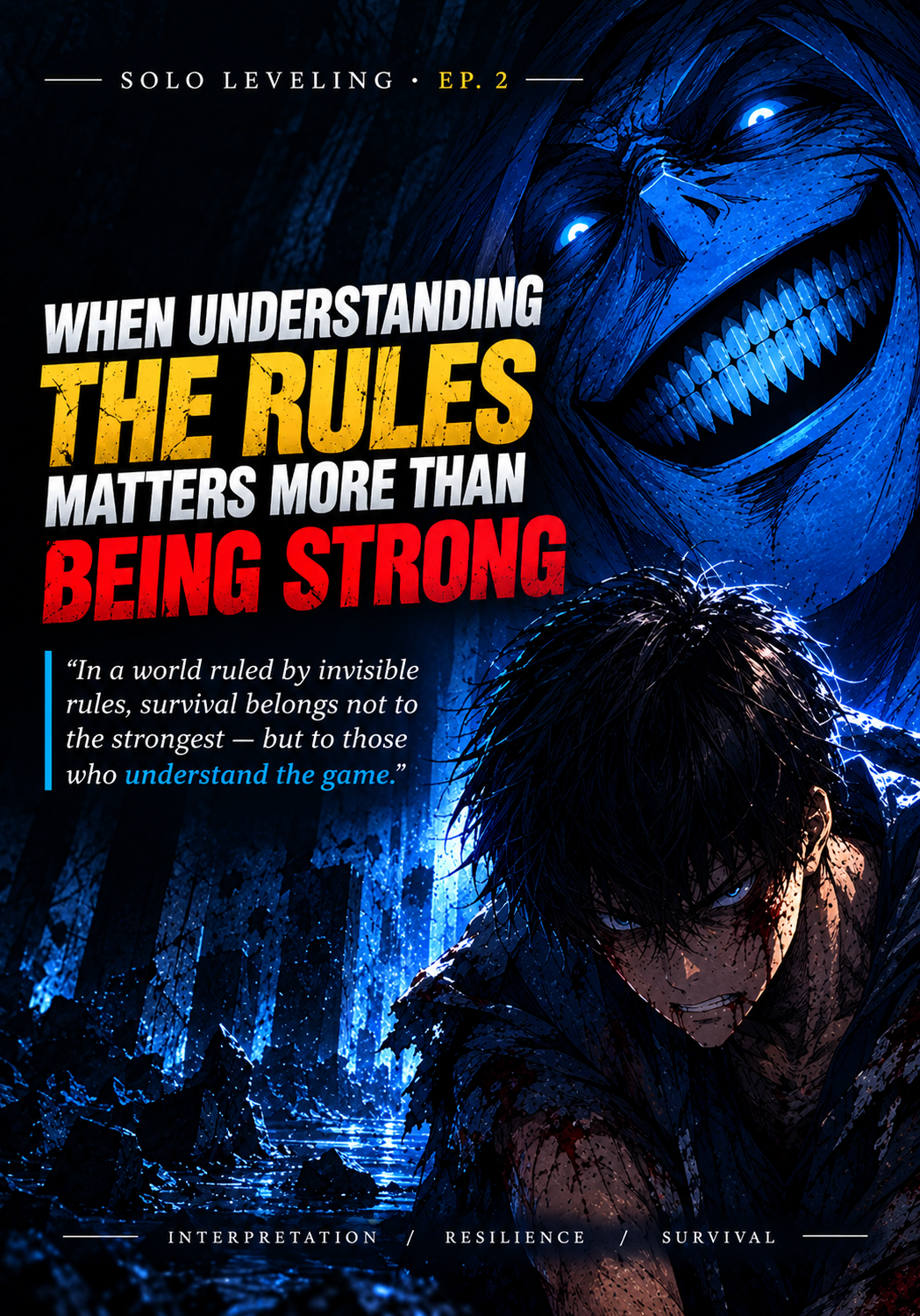
In a world ruled by invisible rules, survival belongs not to the strongest — but to those who understand the game.
The Leveling System
The second episode of Solo Leveling is not about action.
It is about decision-making under pressure, environmental reading, and what remains of humanity when survival demands abandoning others.
Here, the system does not test strength.
It tests interpretation, mental resilience, and the willingness to keep going even when there is no fair outcome.
This is not about winning.
It is about not breaking before the end.
Despair as the starting point
From the very first minutes, the episode establishes a total collapse.
Death, screams, extreme anxiety.
The leader quickly realizes that this is not just a Rank D dungeon.
Everything points to something far greater — possibly Rank A or even Rank S.
At that moment, it becomes clear that strength and mental stability do not always walk together, exemplified by JooHee herself, a Rank B healer who chooses weak raids not because of lack of power, but because of emotional limits.
She is proof that being physically prepared does not mean being psychologically prepared.
The system does not punish mistakes, it punishes misinterpretation
The three laws of the dungeon are simple:
- Worship God
- Praise God
- Prove your faith in God
The problem was never the existence of the rules.
The problem is how humans interpret them while panicking.
Every death inside that dungeon does not happen due to direct disobedience, but because of:
- arrogance,
- personal interpretation,
- lack of emotional control,
- or the attempt to apply values from the outside world to a closed system.
The system does not accept interpretative improvisation.
First law: cold reading amid despair
In the middle of the chaos, Sung Jin-Woo becomes the only one capable of acting, keeping a clear head while everything collapses.
While others react on instinct, attacking, running, freezing, Jin-Woo observes.
He realizes something fundamental:
the laws are neither symbolic nor moral.
They are mechanical.
By asking everyone to kneel, he tests the environment to validate his understanding of the first law, assuming leadership at the moment when no one else can think.
When the statue’s red eyes fade and its smile appears, there is no relief or validation.
Only confirmation that a stage has been cleared.
The statue’s sinister smile does not mean approval.
It means the game continues.
The dungeon does not recognize courage.
It does not recognize faith.
It does not recognize intention.
It only responds when someone understands how it functions.
Second law: interpreting the environment
Here emerges one of humanity’s greatest mistakes: trying to apply personal logic, or the logic of the outside world, to a system that allows no external references.
To praise does not mean to pray the way we do in our world.
It means acting according to what praise means in that environment.
Jin-Woo notices the instruments scattered throughout the hall. From this, he quickly concludes, through environmental observation, that praising, in this context, means making the statues play those instruments.
While some panic, scream, or run, others follow the correct interpretation, observe their surroundings, act according to the game, and survive.
The soundtrack enhances this moment masterfully. Each activated instrument layers into the OST, building tension as the rule is fulfilled.
The system responds only to correct actions, not to intentions.
Third law: faith is not sacrifice
The third law is the cruelest one.
It does not demand human sacrifice.
It demands endurance and trial.
People, represented most clearly by the character Kim, consumed by despair, see an altar and assume that proving faith means sacrificing someone. Kim, in particular, chooses the leader, outsourcing the blame for their situation and emotionally absolving himself.
The leader steps onto the altar.
Nothing happens.
Because the interpretation was wrong.
The open door: the ultimate psychological test
When all characters are on the altar and all blue and red flames are lit, the door opens, and nothing happens to those who leave. The system then reveals its most cruel test.
It is not physical.
It is psychological.
Faith here is not religious.
It is structural.
Remaining inside the circle means trusting the rule,
even when reality presents an apparently safe escape.
Even so, people leave, creating blind spots that lead to the group’s destruction.
The lesson is simple and brutal:
Individual choices can destroy collective survival
Kim: selfishness as a functional strategy
Kim is not an exaggerated villain.
He is the most honest representation of a human under pressure.
He acknowledges that Jin-Woo interpreted everything correctly and that, despite being the weakest in the group, that is precisely why he is still alive.
And even so, he chooses to leave.
His speech about “having a family” is not meant to build empathy.
It is a justification for his selfishness.
As Jin-Woo later realizes:
everyone there had something to lose.
Kim simply used it to mask his true motive — survival.
In the end, the system does not punish Kim, nor selfishness itself.
It even allows him to survive.
But it only recognizes those who accept the cost of staying.
When no fair choice remains
When only three people remain, the dungeon’s logic becomes inevitable:
someone must stay,
someone must die.
The leader offers himself.
But reality is crueler:
JooHee is exhausted.
Jin-Woo cannot walk.
There is no fair solution.
So Jin-Woo decides.
There is no heroic speech.
No glory.
Only logic.
He stays because he is the only one who can.
The massacre and late understanding
Alone, Jin-Woo does not fight to win.
He fights to delay the inevitable.
His thoughts are filled with exhaustion:
“I’ve always been the weakest.”
“I always gave my best.”
“Even so, it wasn’t enough.”
He understands something cruel:
The selfish often survive.
Because they consider only themselves.
This is not a villainous thought.
It is the cold realization of someone who understood the system too late.
The final request: not power, but continuity
At the brink of death, Jin-Woo does not ask for strength.
He does not ask for revenge.
He does not ask for justice.
He asks for one more chance.
Not to become the strongest —
but simply not to die there.
And that is exactly what the system responds to.
The birth of the Player
The message that appears is not a miracle.
It is a selection.
Jin-Woo is not chosen because he is strong.
He is chosen because, beyond correctly reading the system, he remained until the end.
The system does not save him.
It invests in him.
And the episode makes one thing clear:
This story is not about gaining power.
It is about the cost of deserving it.
Conclusion
Episode 2 of Solo Leveling is not merely about rules.
They exist only as instruments.
The true focus of the episode is observing:
- how panic distorts the interpretation of reality,
- how moral values collapse when survival is at stake,
- how selfishness, empathy, and rationalization emerge when no fair exit exists,
- and how different people read the same system in radically different ways.
In the end, it is about how people behave in the face of chaos and what that chaos reveals about them.
In this context, the dungeon functions like a womb:
it crushes, tests, selects, and expels, leaving only those who can endure until the end.
Not through strength, but through psychological resilience.
It does not exist to create monsters.
It simply reveals who each person already was when choices stop being comfortable.
Thus, Sung Jin-Woo is not chosen because he is strong.
Nor because he is good.
Nor because he understands everything.
He is chosen because, from the beginning, he accepts playing within the logic of the system.
While everyone else interprets the rules searching for an escape,
Jin-Woo allows himself to be consumed by them.
And it is this conscious and sustained adherence, not strength, that the system recognizes.
Continue reading
Previous episode: Solo Leveling — Episode 1